
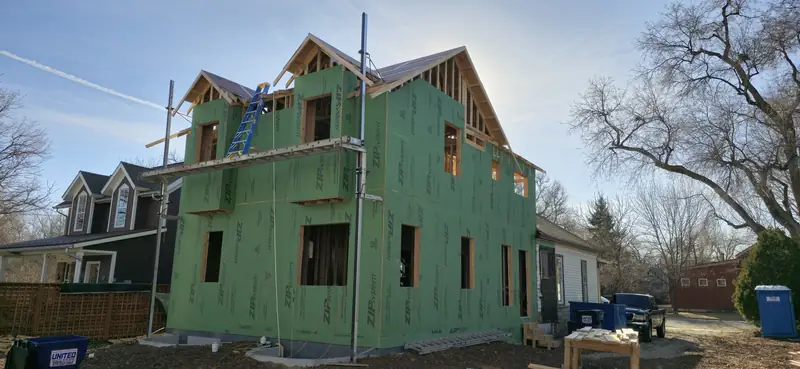
Water is the leading cause of damage to houses. And when a wall rots, the problem usually isn't a bad product. It's how the details were put together, and in what order.
Windows are the riskiest spot on most walls. Every window is a hole cut through the layers that keep rain out, and many leaks start at the opening around the window rather than the glass. Even good windows can leak at their corners and frame joints, so a good builder plans for the possibility that some water will eventually get past the window, and gives that water a way back out.
Flashing is drainage, not glue
Flashing is the set of membranes, tapes, and metal pieces that catch water and steer it back outside. Good flashing follows a few simple rules:
- It overlaps like shingles. Upper layers lap over lower ones, so water running down always lands on the outside of the next piece, never behind it.
- It drains to the outside. Water that gets in needs a path out.
- It's continuous. A gap at a corner is a gap.
- It outlasts what it protects. Siding can be replaced. Rotted framing behind it is a much bigger job.
Caulk on its own isn't flashing. It cracks, shrinks, and pulls away, and once it does, there's nothing behind it.
What a well-flashed window opening has
- A sill pan. The bottom of the opening is turned into a shallow tray, with its corners sealed, so any water that gets past the window drains out instead of into the wall.
- An unsealed bottom flange. The sides and top of the window get sealed and taped, but the bottom flange is left open so water in the sill pan can drain out. That's the approach in ASTM E2112, the industry's standard practice for installing windows.
- Tape lapped in the right order. Bottom first, then the sides, then the top, so every layer sheds water onto the one below it. Tape installed in the reverse order funnels water into the wall.
- The window tied into the house wrap. The weather barrier on the wall and the flashing around the window should work as one layer.
- A drip at the head. A small piece of flashing over the top of the window kicks water out and away.
Tape isn't magic
Modern flashing tapes are excellent, but tape can't defeat gravity, drain a lot of water by itself, or fix a badly shaped opening. It only sticks well to clean, dry surfaces within its temperature range, which matters on cold Colorado mornings. It also has to be protected from damage by later trades.
What to ask before a window or door project
- How will the bottom of the opening drain if water gets past the window?
- Will the new flashing tie into the existing weather barrier?
- What happens at the top of the window?
Clear answers to those three questions are a good sign.